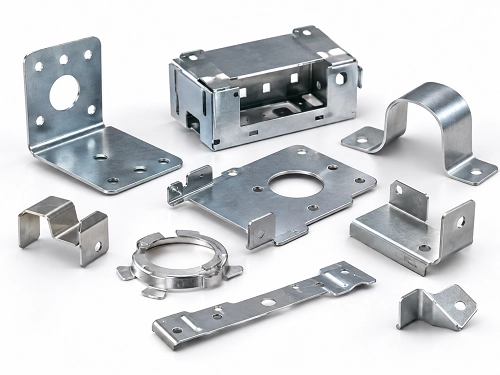
Stamping (also called pressing) places flat sheet metal, in blank or coil form, into a press where a tool and die surface forms it into a net shape. It covers several operations, including punching, blanking, embossing, bending, flanging and coining, as described in the general reference entry on metal stamping. ACRO’s explainer on what metal stamping is adds deep drawing to that list and describes the result as repeatable, high-accuracy parts.
The appeal is consistency at volume. Once the tooling is proven, every stroke of the press produces the same geometry. That is why stamping dominates medium- to high-volume work in automotive, appliances, furniture, medical devices and construction hardware.
Process choice drives tooling cost, part quality and lead time more than almost any other decision. ACRO lists progressive, transfer, compound and deep-drawing stamping among its production processes. The table below summarizes how they differ in practice. It is general engineering guidance, not a quotation.
| Process | How it works | Best suited for | Watch out for |
|---|---|---|---|
| Progressive | A coil strip advances one station per stroke; each station cuts, bends or forms | Small to medium parts at high volume, such as clips, brackets and terminals | Higher die cost and a longer tryout; strip layout must be engineered carefully |
| Transfer | The blank is separated from the strip and moved between stations | Larger or deeper parts that cannot stay attached to a carrier strip | Slower than progressive for small parts; part handling must be controlled |
| Compound | Several cutting operations, typically blanking and piercing, in one stroke | Flat parts such as washers and plates where flatness matters | Limited for parts that need significant forming |
| Deep drawing | Sheet is drawn into a cavity to form cup or box shapes | Housings, enclosures and cookware-style shapes | Wrinkling and tearing if material, radii and lubrication are not matched |
For a deeper look at how a progressive die builds a part station by station, the Xometry progressive die stamping guide is a useful independent reference.
Figure 1. Simplified progressive die layout (original illustration, free to use):
The ranges below are published by ACRO for custom stamping work. Treat them as design-stage guidance, since the final tolerance always depends on part geometry, material and the forming steps involved.
| Parameter | Range or options |
|---|---|
| Material thickness | 0.1 mm – 6.0 mm (custom ranges available) |
| Materials | Carbon steel, stainless steel (304, 316, etc.), aluminum alloys, copper and brass |
| Dimensional tolerance | ±0.01 mm to ±0.1 mm, depending on design and material |
| Surface treatments | Zinc plating, nickel plating, powder coating, anodizing, passivation |
| Processes | Progressive, transfer, compound, deep drawing |
| Supply capacity | 300,000 pieces per month; samples in 3–7 days |
The following points are general metal-forming practice. They are the questions an experienced tooling engineer will usually raise during a design review.
The honest answer is that stamping is front-loaded. As ACRO explains in its article Is Metal Stamping a High-Cost Investment?, the main expense is usually the die and equipment, not the individual part. Die cost rises with complexity and precision requirements, and it is spread across the production run. At volume, the price per part falls sharply.
A practical way to apply this is to compare options on total landed cost per part over your expected lifetime volume rather than on unit price alone. For prototypes or very small runs, machining or 3D printing may be more economical because there is no die to amortize. Once demand is stable and in the thousands or more, stamping typically becomes the stronger candidate. ACRO’s own guidance is that stamping suits medium- to large-scale production.
More industry examples are collected on the applications page.
Capability claims are easy to make and harder to verify. These checks help buyers separate marketing from evidence:
What do I need to send for a quote?
ACRO works from customer drawings, samples or technical requirements. Include material, thickness, tolerances, surface finish and expected annual volume, because volume largely determines the right tooling strategy.
How long do samples take?
ACRO states samples are available in 3–7 days, though timing for complex tooling will vary.
Can stamping handle welded or assembled products?
Yes. Stamped components are often combined with welding parts and assembly parts into finished sub-assemblies, which reduces the number of suppliers you need to coordinate.
Is stamping right for low volumes?
Usually not for a handful of pieces, since tooling cost cannot be spread across enough parts. It becomes attractive as volumes grow.