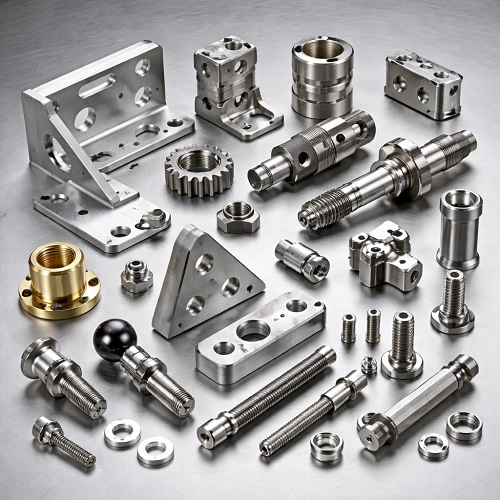
In modern manufacturing and engineering, the demand for customized solutions has driven the proliferation of non-standard assembly parts—components designed or adapted for specific functions that fall outside the realm of commonly stocked or catalogued hardware. These parts provide tailored performance, enhanced integration, and often contribute directly to a system’s competitive advantage.
Non-standard assembly parts are components that are uniquely designed or modified to satisfy specific performance, geometric, or functional requirements that cannot be met with off-the-shelf items. They may be one-off custom pieces, parts modified from standard components, or bespoke engineered elements created for a particular use case.
Standard components are designed to be broadly applicable but often involve performance trade-offs. Non-standard parts remove these limitations by being tailored to the specific loads, tolerances, motion profiles, and environments of the application.
In industries such as aerospace and medical devices—where every gram and cubic millimeter matters—non-standard parts allow packaging and integration that standard components simply cannot offer.
Pioneering products often require parts that do not yet exist in catalogs.
While custom parts can have higher initial costs, in high-volume production they may reduce assembly time, scrap rates, service costs, and warranty claims, leading to lower total cost of ownership.
The stringent performance, safety, and certification requirements in aerospace make generic parts insufficient in many cases.
Because reliability is paramount, these parts typically undergo extensive testing, material qualification, and traceability processes.
Modern vehicles, especially electric and autonomous platforms, integrate complex subsystems that standard parts can’t always satisfy:
OEM strategies increasingly blend off-the-shelf parts with non-standard ones to optimize cost and performance.
Robots and automated systems are often designed for specific tasks like precision welding, materials handling, or surgical assistance.
These parts often require top-tier precision to maintain repeatability and safety.
Non-standard components are vital to maintaining uptime and extending service intervals.
Although consumer devices are mass-produced, their custom parts are essential for differentiation.
Medical devices must meet exacting regulatory standards.
Here, materials and processes must align with safety and sterilization requirements.
Understanding functional, environmental, regulatory, and lifecycle requirements is the foundation of effective custom part design.
Choices should balance strength, weight, corrosion resistance, manufacturability, and cost. High-performance alloys, composites, and engineered plastics are common.
Each process influences cost, lead time, and tolerances.
Custom parts often interface with other system elements. Proper geometric dimensioning and tolerancing (GD&T) ensures assembly consistency and reliability.
Custom parts usually require tailored inspection plans, including non-destructive testing, functional testing, or lifecycle validation.
Custom parts generally have longer lead times. Strategic planning and supplier collaboration can mitigate delays.
Initial tooling and design costs are higher, but careful upfront analysis and scalable production planning can balance expense over project life.
Trustworthy partnerships with suppliers capable of precision manufacturing and iterative design are critical.
Effective mitigation often involves modularization, digital twin simulation, and collaborative design platforms.
Generative design and AI-driven optimization tools are enabling engineers to create custom parts that are lighter, stronger, and quicker to prototype.
3D printing is lowering barriers to producing complex custom geometries without expensive tooling.
Non-standard parts increasingly embed sensors and connectivity, blurring lines between mechanics and electronics.
Designs that minimize waste and support recycling or remanufacturing are becoming standard expectations in new custom parts.
Non-standard assembly parts are no longer niche elements—they have become strategic assets across industries. From aerospace structures and automotive subsystems to robotics tooling and medical implants, these parts unlock performance that generic components cannot match. While they bring complexity and require thoughtful engineering, their ability to tailor solutions exactly to the task makes them indispensable in competitive, high-performance environments.